
NetScaler Console service use cases
Citrix Aidrien™ is your intelligent assistant designed to simplify and accelerate troubleshooting and environment analysis within your NetScaler infrastructure. Powered by deep integration with NetScaler infrastructure and telemetry, Citrix Aidrien understands your environment contextually, allowing it to surface relevant data, assist with diagnostics, and guide you through resolution steps using natural language queries.
Whether you're investigating upgrade readiness, vulnerability assessment or reviewing instance resource utilization, Citrix Aidrien reduces the time spent navigating multiple consoles, correlating logs, and searching documentation by delivering insights directly within your workflow. Citrix Aidrien is available in Citrix Cloud™ across NetScaler Console Service, making it a seamless part of your daily operations.
NetScaler environment data
-
Software versions: Citrix Aidrien can list the software versions and build numbers installed on your NetScaler appliances. Monitoring is critical for identifying and patching NetScaler instances with known security vulnerabilities, ensuring compatible and supported versions across all appliances, especially in standalone, High Availability (HA), and cluster deployments. Here are a few examples:
-
"How many of my NetScaler instances are running a build version earlier than 14.1-38.x?"
-
"Which specific build versions are currently deployed across my NetScaler environment?"
-
-
Health and status: Monitor the operational status and health state (For example: Up, Down, out of service) of your NetScaler instances. This check provides immediate visibility for quick identification of issues, meeting SLAs, and initial troubleshooting. Here is an example:
-
"How many NetScaler are currently in a ‘Down’ or ‘Out of Service’ state?"
-
-
Deployment modes: Understanding the deployment mode of the NetScaler instances (for example, Standalone, HA pair, Cluster) is fundamental for assessing redundancy, planning maintenance, understanding the traffic flow, gaining insight into the design, and scalability of your NetScaler infrastructure, and initial troubleshooting. Here are a few examples:
-
"Which of my NetScaler appliances are deployed in HA mode or as part of a Cluster?"
-
"Identify all NetScaler instances currently configured as the ‘Primary’ node within an HA pair."
-
-
Enabled features: Lists the specific features currently activated or configured on your NetScaler appliances (for example, Load Balancing, WAF, GSLB). This list provides insight into functional capabilities, resource consumption, licensing compliance, and security posture, providing verifiable proof of enabled security and performance features for compliance audits. Here are a few examples:
-
"What features are currently enabled on my NetScaler appliances?"
-
"Which NetScaler instances have the Web Application Firewall (WAF) feature actively configured?"
-
"List all instances where Global Server Load Balancing (GSLB) is currently deployed."
-
-
Health metrics and capacity planning: Citrix Aidrien provides visibility into real-time and historical performance data to assist with capacity management and resource optimization. Some metrics include CPU, Memory, Disk Usage, HTTP Req/sec, RX, TX, SSL cards, and SSL Cores Up metrics. Here are a few examples:
-
"What’s the CPU usage of my top NetScaler instances?"
-
"Show HTTP request rate, throughput, and usage stats for instance 192.0.2.190."
-
"Are SSL cards and network interfaces enabled and functioning?"
-
"Retrieve health statistics and usage data for my environment."
-
-
SSL certificate health and SSL configuration visibilityCitrix Aidrien provides deep visibility into SSL certificate inventory and SSL/TLS configuration across all managed NetScaler instances.This feature enables certificate lifecycle management, stronger security posture, and reduced risk of service disruptions caused by certificate expiration or weak cryptographic configurations.The capabilities include complete certificate inventory and usage across instances, instance bindings, expiry monitoring and risk indicators, expiring-soon alerts, risk-based visibility of certificates nearing expiration, centralized expiry tracking, cryptographic strength key size validation, signature algorithm identification, issuer visibility, detection of weak or deprecated cryptographic standards, SSL/TLS Configuration Assessment, SSL/TLS protocol usage, key-exchange (ephemeral RSA and Diffie-Hellman) visibility, SSL feature enablement across instances.Example prompts:
-
“Show all SSL certificates expiring within the next 30 days.”
-
“Which certificates are using SHA-1 signatures?”
-
"List the certificates on intsance 192.0.2.13 and show which are unused."
-
“Are any instances using deprecated SSL/TLS protocols?”
-
“Provide SSL key size and issuer details for my environment.”
This use case helps administrators avoid outages, ensure compliance, and maintain strong encryption standards. -
-
Network Functions — Virtual Server and Entity VisibilityCitrix Aidrien exposes the operational state, configuration, and bindings of all major NetScaler network entities. Unlike appliance-level health checks, this capability resolves to the individual entity level — virtual servers, services, service groups, and servers — enabling application-specific triage, configuration audits, and cross-entity correlation across your entire NetScaler estate without navigating multiple consoles.The following entity groups are supported: Load Balancing (lbvserver, services, service groups, and servers), Content Switching (csvserver), NetScaler Gateway (vpnvserver), Authentication (authenticationvserver), Cache Redirection (crvserver), and Global Server Load Balancing (GSLB vServers, services, and sites).For each entity, Aidrien surfaces status, effective state, and bindings as the primary attributes.
-
Load BalancingAidrien queries all load balancing virtual servers (lbvservers) across your estate and resolves their bound services, service groups, and backend servers in a single interaction. You can identify which virtual servers are degraded, trace a state problem to a specific backend server, and verify that the correct load balancing method and persistence policy are in place — without opening the NetScaler console.Example prompts:
-
"Which lbvservers across my estate are not in an UP state?"
-
"Show me all services and service groups bound to vs_app_443 on 192.0.2.16 and their individual states."
-
"Which lbvservers have all their bound services Down?"
-
"What servers back service group svcgrp_app on 192.0.2.16, and are they all UP?"
-
"What load balancing method and persistence policy is configured on vs_internal_8080?"
-
-
Content SwitchingCitrix Aidrien retrieves the full policy binding configuration for all content switching virtual servers (csvservers), including the priority order of bound policies, their target lbvservers, and the default backend when no policy matches. This lets you quickly understand traffic routing decisions and detect misrouting caused by a degraded target lbvserver.Example prompts:
-
"Show all csvservers on instance 192.0.2.16 and their current states."
-
"What policies are bound to cs_www_443 and which lbvservers do they target?"
-
"Are there any csvservers where the default or a policy-target lbvserver is currently Down?"
-
"What is the default backend for cs_api_gateway if no content switching policy matches?"
-
-
NetScaler GatewayCitrix Aidrien surfaces the state, effective state, and configuration of all NetScaler Gateway virtual servers (vpnvservers) across your estate. You can identify which Gateway entry points are unavailable, and which instances have an active Gateway vServer configured, giving you immediate visibility into remote access availability without instance-by-instance inspection.Example prompts:
-
"Which Gateway vServers across my estate are currently Down?"
-
"Show me all NetScaler Gateway virtual servers on instance 192.0.2.20 and their states."
-
"How many instances have an active Gateway vServer configured?"
-
"Is vpn_gateway_443 on 192.0.2.16 UP and what is its effective state?"
-
-
Authentication Virtual ServersCitrix Aidrien enumerates all authentication virtual servers (authenticationvservers) across your NetScaler estate and reports their operational state. This is particularly useful for identifying authentication bottlenecks or outages affecting single sign-on flows, without separately querying each managed instance.Example prompts:
-
"List all authentication vServers across my estate and their current states."
-
"Which authentication vServers on instance 192.0.2.16 are not UP?"
-
"Show me the configuration and state of authvserver auth_aaa_443."
-
-
Cache RedirectionCitrix Aidrien reports the state and target bindings for all cache redirection virtual servers (crvservers) across your estate. You can determine which crvservers are degraded and identify the origin or target lbvserver associated with a given cache redirection configuration.Example prompts:
-
"Show all cache redirection vServers on instance 192.0.2.16."
-
"Which crvservers across my estate are currently not in an UP state?"
-
"What origin server is bound to crvserver cr_web_80?"
-
-
Global Server Load Balancing (GSLB)Citrix Aidrien surfaces the operational state of all GSLB virtual servers, their bound GSLB services, and the configured GSLB sites across your estate. You can detect site-level failures, identify GSLB vServers that are Down, and verify whether all participating sites are reachable — enabling rapid diagnosis of global traffic disruptions without manually checking each participating instance.Example prompts:
-
"Which GSLB vServers across my estate are currently Down?"
-
"Show all GSLB services bound to gslb_app_www and their site states."
-
"What GSLB sites are configured on instance 192.0.2.16 and are they all UP?"
-
"Which instances have GSLB configured and how many GSLB vServers are active?"
-
"Is the AP-South GSLB site reachable from instance 192.0.2.16?"
-
-
Specialized use cases
Citrix Aidrien goes beyond surface-level diagnostics by offering deep, contextual troubleshooting through special-purpose sub-agents. These agents are designed to extend Citrix Aidrien’s intelligence beyond data retrieval to automation, validation, and guided execution.
Security Advisory
Citrix Aidrien reads the results of all four NetScaler Console Security Advisory scans — CVE detection, secure configuration, File Integrity Monitoring and Indicators of Compromise — together with the status of each scan, including when it last ran and whether it completed or failed.
CVE detection and remediation
Citrix Aidrien integrates with NetScaler Console Security Advisory and CVE databases to identify, assess, and guide remediation of vulnerabilities affecting your NetScaler appliances. It can detect known CVEs applicable to deployed builds, provide remediation steps and references, and highlight instances at risk due to outdated builds or configurations.
Examples:
-
"Is my instance 192.0.2.16 vulnerable to known security issues?"
-
"List all NetScaler instances impacted by recent CVEs."
-
"Show remediation guidance for identified vulnerabilities."
-
"Which CVEs are relevant to my environment based on my current build and configuration?"
-
"Show me a fleet-wide CVE risk summary across all my NetScaler instances."
Secure Configuration Recommendations
Citrix Aidrien can surface and explain open secure configuration recommendations from the NetScaler Console Security Advisory. For a specific instance or across the entire managed estate, it identifies configuration gaps — such as deprecated TLS protocols, weak cipher suites, and WAF policy mode — and explains the associated risk level and the remediation action required.
Examples:
-
"What secure configuration recommendations are outstanding for instance 192.0.2.16?"
-
"Which of my NetScaler instances have high-risk configuration issues flagged?"
-
"Show me all instances where TLS 1.0 or 1.1 is still enabled."
-
"Summarize the open secure configuration recommendations across my entire NetScaler estate."
-
"Which recommendations on 192.0.2.20 have already been applied?"
File Integrity Monitoring
Citrix Aidrien can query File Integrity Monitoring (FIM) events from the NetScaler Console Security Advisory. FIM detects and records unauthorized or unexpected changes to critical files on managed NetScaler instances using two methods:
-
Console-detected: Compares SHA-256 file hashes against the known-good baseline for the instance’s build
-
Device-reported: The appliance’s binary fingerprinting (veriexec) flags executables that have no trusted fingerprint.
Citrix Aidrien surfaces these events, identifies which files were added or modified on which instances, and helps you assess whether a detected change is expected, such as after a scheduled upgrade, or potentially anomalous.
Examples:
-
"Have any of my NetScaler instances reported file integrity alerts this week?"
-
"Show FIM events for instance 192.0.2.16 in the last 7 days."
-
"Which files were modified on 192.0.2.20 — is this consistent with the upgrade that ran yesterday?"
-
List all instances where /nsconfig/ns.conf has been changed in the past 30 days."
-
"Are there any FIM alerts on instances that are not currently in a maintenance window?"
Indicators of Compromise
Citrix Aidrien reports the results of the Indicators of Compromise (IoC) scan for each instance — for example, whether an instance is marked Potentially Compromised — and explains why a scan did not run or failed. It combines these results with File Integrity Monitoring and CVE findings to help you decide what to investigate first.
Examples:
-
"Show the Indicators of Compromise results for my NetScaler instances."
-
"Instances 192.0.2.31 and 192.0.2.33 are marked Potentially Compromised. What should I do next?"
-
"Why did my IoC scan fail?"
Trigger Security Scans (CVE, Secure Configuration, File Integrity, IoC)
Citrix Aidrien can start an on-demand NetScaler Console Security Advisory scan from the conversation, without opening the Console. It can run CVE detection, secure configuration, FIM, any combination of them, or all three at once. IoC scans are started separately. Scans run immediately; they can't be canceled from Citrix Aidrien.
-
Scope: Secure configuration, FIM, and IoC scans can cover the whole estate or only the instances you name. CVE detection always covers the whole estate, and Citrix Aidrien says so if you name specific instances.
-
Preview first: Before anything runs, Citrix Aidrien shows what the scan covers, how many instances are there, how fresh the current results are, and whether a scan is already running. The scan is submitted only after you explicitly confirm.
-
Target checks: Every named instance is verified as managed and up. If one isn't, the request is declined; it never quietly widens to the whole estate.
-
Safe to run: Scans are read-only assessments and don't change NetScaler configuration.
-
Results come later: Scans run in the background. Citrix Aidrien confirms the scan is queued and can check the results on a later turn.
-
Proactive offers: When results are stale, incomplete, or missing, Citrix Aidrien offers to run a fresh scan. When Secure Config or FIM coverage was incomplete, the offer covers only the instances that were skipped. It also points to the Console's Scan Now button.
Examples:
-
"Run a fresh CVE scan across all my NetScaler instances."
-
"Rescan secure configuration on 192.0.2.16 and 192.0.2.20."
-
"Run a file integrity scan on the instances that were skipped last time."
-
"Rescan everything: CVE, Secure Config, and FIM."
-
"Run an IoC scan on 192.0.2.16."
Security Scan History (CVE, Secure Configuration, File Integrity, IoC)
Citrix Aidrien can report when each NetScaler Console Security Advisory scan last ran, and whether its results are still current. For CVE detection, secure configuration recommendations and file integrity monitoring (FIM), it returns the latest completed whole-estate scan: its status, start and end times, whether it was scheduled or on-demand, who started it (for on-demand scans), and when the next scheduled scan is due. It then explains how far to trust the results:
-
Fresh: Completed and not overdue.
-
Stale: The next scheduled scan is overdue.
-
Incomplete: Some instances weren't covered, for example because they were down or unreachable.
-
Not run: No completed whole-estate scan of that type in the last 14 days, which is as far back as the scan history goes. Scans run on specific instances aren't counted here, so a type can be shown as not run even after a recent scan of selected instances.
Citrix Aidrien never presents "no scan" as "no findings". When it answers "am I affected?" for a CVE, it checks whether the last CVE scan ran before that CVE was published. If so, it warns that the results can't yet show the CVE, rather than reporting the estate as clean.
-
Indicator of Compromise (IoC) scans are tracked separately:
-
Latest run: Its status (scheduled, in progress, completed or error), when it ran and, for on-demand scans, who started it.
-
Per-instance verdict: Whether each instance shows a potential compromise, with the specific checks that flagged it.
-
Detection definitions: The version of the IoC detection script, so you know how current they are.
An instance missing from the latest IoC run is reported as not scanned, not as clean. An IP that isn't a managed instance is called out as invalid. Full scan reports stay in the Console's Scan History tab.
Examples:
-
"When did the last CVE scan run on my NetScaler estate, and when is the next one due?"
-
"Are my secure configuration and file integrity results up to date?"
-
"Show me the latest scan status for CVE, Secure Config, and FIM."
-
"When was the last IoC scan run, and did it find any potential compromise?"
-
"Was 192.0.2.16 included in the latest IoC scan?"
-
"Which version of the IoC detection script is my Console using?"
NetScaler upgrade assistant
The NetScaler Upgrade Assistant is a specialized Citrix Aidrien sub-agent designed to assist administrators with upgrade readiness and orchestration. Unlike contextual queries, this workflow uses dedicated upgrade utilities and validation tools to perform environment assessments and guided upgrade preparation.
Here's how Citrix Aidrien transforms these workflows:
Upgrade readiness and planning
-
Detects NetScaler instances running EOL/EOM or latest/non-recommended builds.
-
Maps build versions to known CVEs and recommends upgrade paths.
-
Performs pre-upgrade validation (checks customizations, configurations, dependencies, and health).
-
Identifies blocking issues with detailed resolution guidance.
-
Provides a readiness summary and directs users to initiate the upgrade from NetScaler Console.
Upgrade scheduling
Citrix Aidrien enables administrators to schedule NetScaler upgrades through a guided workflow within NetScaler Console. When an upgrade is requested for a specific instance, Citrix Aidrien evaluates the current build, security posture, and overall compatibility, recommends an appropriate target build, and performs readiness validation before scheduling. Administrators might proceed with the Citrix Aidrien recommended build or explicitly select an alternate target build version.
Upgrades are scheduled by specifying a maintenance window in UTC, after which Citrix Aidrien automatically creates the upgrade job using the default configuration settings.
Following the readiness confirmation, the workflow includes:
-
Confirmation of upgrade intent
-
Automated pre-upgrade validation checks
-
Configuration of the upgrade schedule
-
Creation of the upgrade job, which you can view and manage in NetScaler Console
This streamlined process ensures a controlled, validated, and auditable upgrade lifecycle.
Example prompts:
-
“Schedule upgrade for instance 192.0.2.16 this Saturday at 23:00 UTC.”
Build comparison analysis
-
Full build comparisonThe capabilities include comparison between two releases or builds, clearly articulating fixed issues and enhancements between the source and target builds, and listing known issues in the target build.Example prompts:
-
“Compare build 14.1-47.48 & 14.1-60.52”
-
“What security fixes are included in the latest recommended build?”
-
-
Instance level build comparison analysisBased on enabled features and configuration of your NetScaler instance, Citrix Aidrien provides a contextualized analysis of release notes. The capabilities include comparison between two releases or builds clearly articulating fixed issues and enhancements between the source and target builds, and listing known issues in the target build. Citrix Aidrien will generate a downloadable environment-specific release note summary.Example queries:
-
“Perform release notes analysis for instance 192.0.2.16.”
-
Contextual dashboard intelligence (“Analyze with Citrix Aidrien”)
Citrix Aidrien provides predefined contextual insights directly within key dashboards in NetScaler Console service. These contextual responses reduce analysis time by providing pre-populated summaries tailored to the dashboard view, eliminating the need for manual filtering and correlation.
When administrators click Analyze with Citrix Aidrien, they receive intelligent summaries specific to that dashboard scope.
Supported Dashboards
-
Instance Inventory Dashboard
-
Analyze the health stats, features enabled, and security advisory details of a specific NetScaler/Citrix ADC instance selected.
-
Select an instance and click “Analyze with Citrix Aidrien” to get the instance advisory.

-
-
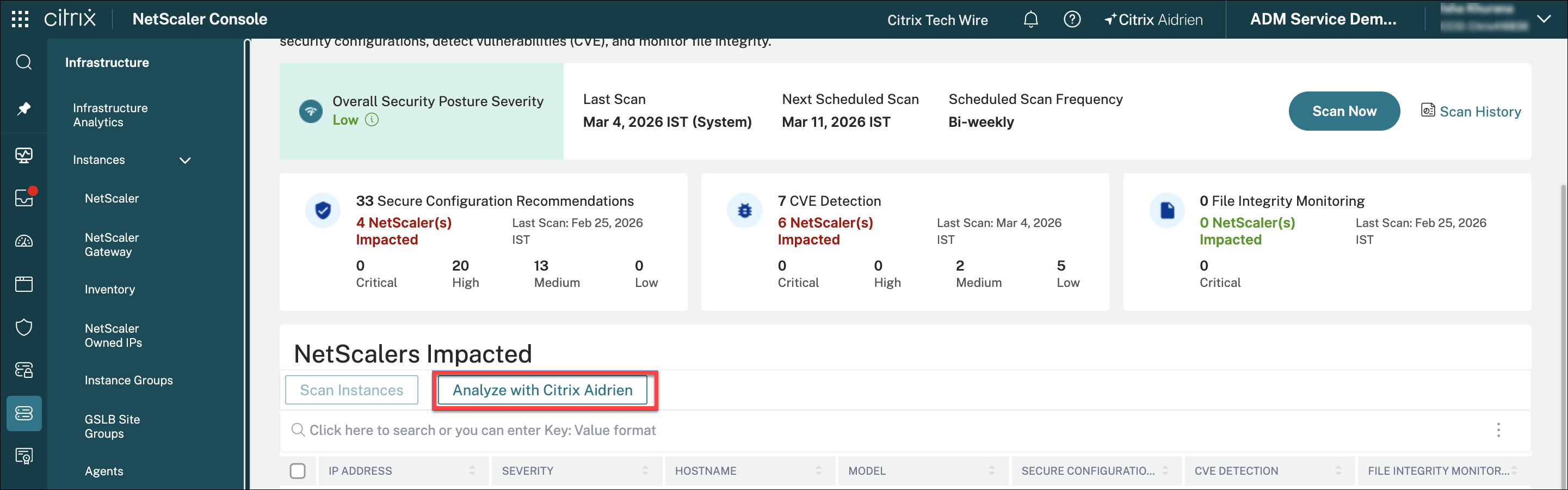
Security Dashboard
-
Analyze the security recommendations and CVE exposure summary for all or specific NetScaler instances.
-
Select an instance and click “Analyze with Citrix Aidrien” to get security advisory for the selected instance.
-
Click “Analyze with Citrix Aidrien” without selecting an instance to get the security advisory for all NetScaler instances.
-
-
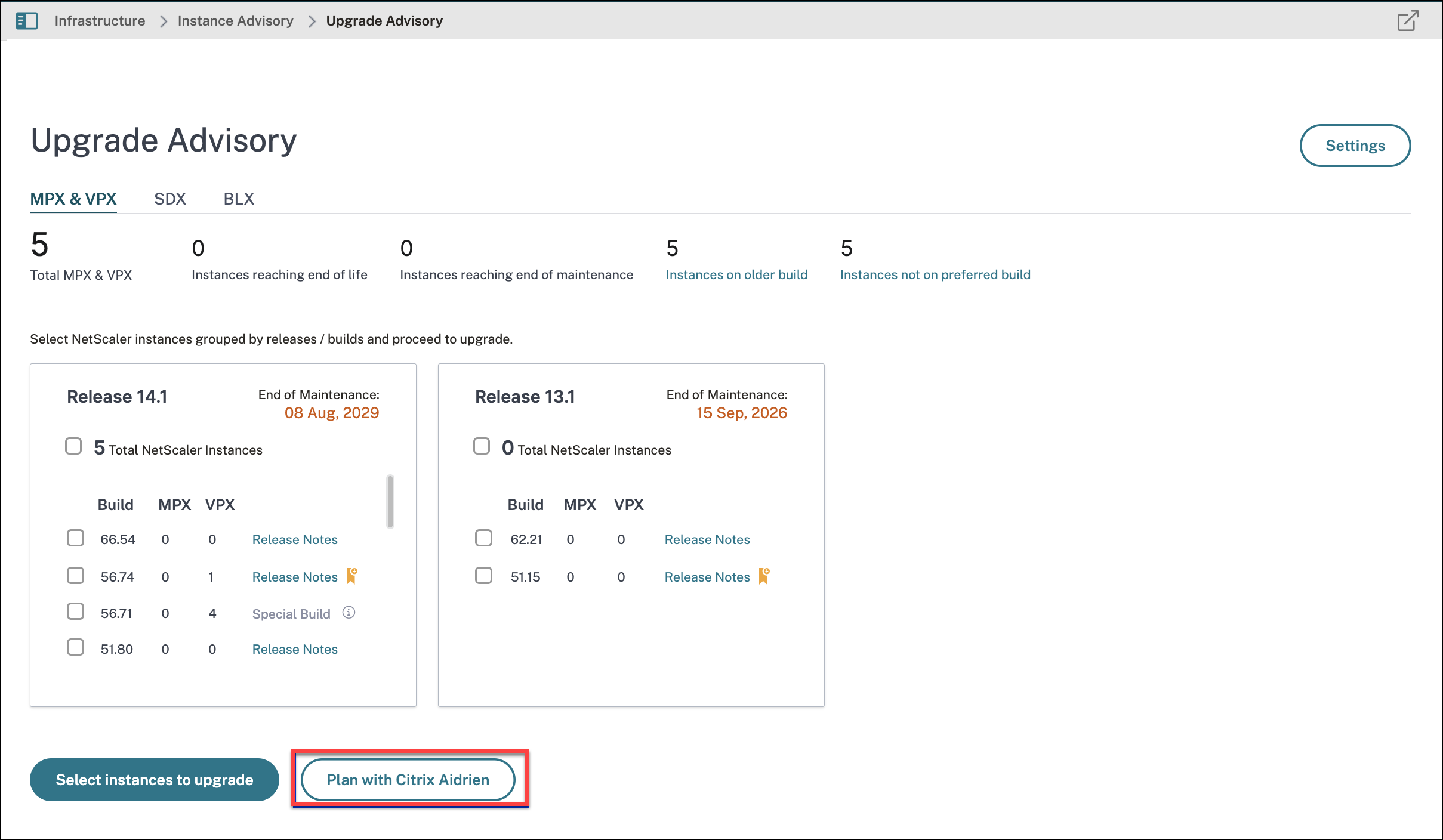
Upgrade Advisory Dashboard
-
Analyze the NetScaler inventory, CVE remediation mapping, readiness summary, upgrade path, and upgrade scheduling.
-
Click Plan with Citrix Aidrien to get the upgrade advisory for all NetScaler instances.
-