
-
Endpoint Management integration with Microsoft Endpoint Manager
-
Certificates and authentication
-
Client certificate or certificate plus domain authentication
-
Authentication with Azure Active Directory through Citrix Cloud™
-
Authentication with Azure Active Directory Group-Based Administration
-
Authentication with Azure Active Directory through Citrix Gateway for MAM enrollment
-
Authentication with Okta through Citrix Gateway for MAM enrollment
-
Authentication with an on-premises Citrix Gateway through Citrix Cloud
-
-
Declarative Device Management policies
-
App Settings device policy
-
-
Compliance Enforcement for Android device (Technical Preview)
This content has been machine translated dynamically.
Dieser Inhalt ist eine maschinelle Übersetzung, die dynamisch erstellt wurde. (Haftungsausschluss)
Cet article a été traduit automatiquement de manière dynamique. (Clause de non responsabilité)
Este artículo lo ha traducido una máquina de forma dinámica. (Aviso legal)
此内容已经过机器动态翻译。 放弃
このコンテンツは動的に機械翻訳されています。免責事項
이 콘텐츠는 동적으로 기계 번역되었습니다. 책임 부인
Este texto foi traduzido automaticamente. (Aviso legal)
Questo contenuto è stato tradotto dinamicamente con traduzione automatica.(Esclusione di responsabilità))
This article has been machine translated.
Dieser Artikel wurde maschinell übersetzt. (Haftungsausschluss)
Ce article a été traduit automatiquement. (Clause de non responsabilité)
Este artículo ha sido traducido automáticamente. (Aviso legal)
この記事は機械翻訳されています.免責事項
이 기사는 기계 번역되었습니다.책임 부인
Este artigo foi traduzido automaticamente.(Aviso legal)
这篇文章已经过机器翻译.放弃
Questo articolo è stato tradotto automaticamente.(Esclusione di responsabilità))
Translation failed!
App Settings device policy
The App Settings device policy lets you configure app allow and deny lists using Apple’s Declarative Device Management. It replaces the deprecated allowListedAppBundleIDs and blockedAppBundleIDs restriction keys. This policy only supports supervised devices.
To add or configure this policy, go to Configure > Device Policies. For more information, see Device policies.
Prerequisites
- CEM version is equal to or greater than 26.8.0.
- Available for iOS 27 or later and iPadOS 27 or later, only support supervised devices.
iOS settings
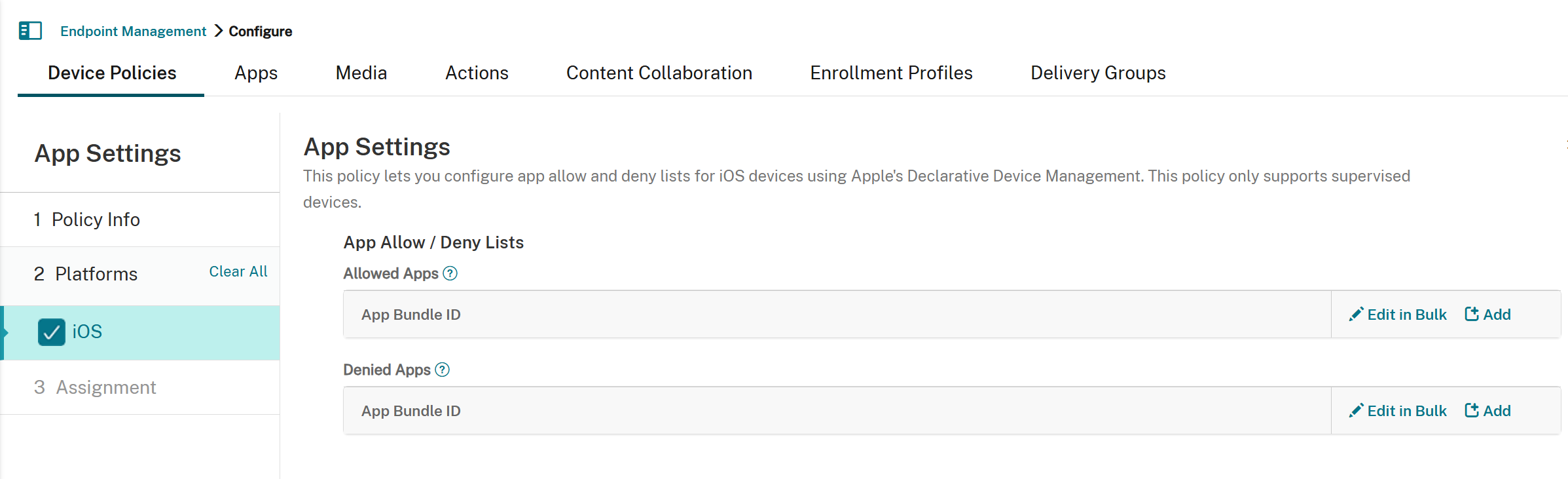
-
App Allow / Deny Lists
-
Allowed Apps: If present, the device only shows or launches apps with bundle IDs in the list. Include the value
com.apple.webappto allow all webclips. This applies to App Store apps, marketplace apps, and locally installed apps (using Configurator, Xcode, and so forth).- App Bundle ID: To add App Bundle ID, click Add, type an App Bundle ID, and click Save. Repeat that process for each app bundle ID you want to add. You can also click Edit in Bulk, enter or paste app bundle IDs, one per line or separate by commas, and click Save.
-
Denied Apps: If present, the device prevents showing or launching apps with bundle IDs in the list. Include the value
com.apple.webappto restrict all webclips. This applies to App Store apps, marketplace apps, and locally installed apps (using Configurator, Xcode, and so forth).
-
Note:
Denying system apps may disable other functionality. For example, denying the App Store app may prevent users from accepting the terms and conditions for the user-based Volume Purchase Program (VPP). We recommend that you configure either the App Allow list or the App Deny list, but not both.
Share
Share
In this article
This Preview product documentation is Citrix Confidential.
You agree to hold this documentation confidential pursuant to the terms of your Citrix Beta/Tech Preview Agreement.
The development, release and timing of any features or functionality described in the Preview documentation remains at our sole discretion and are subject to change without notice or consultation.
The documentation is for informational purposes only and is not a commitment, promise or legal obligation to deliver any material, code or functionality and should not be relied upon in making Citrix product purchase decisions.
If you do not agree, select I DO NOT AGREE to exit.